TDSR Calculator Singapore
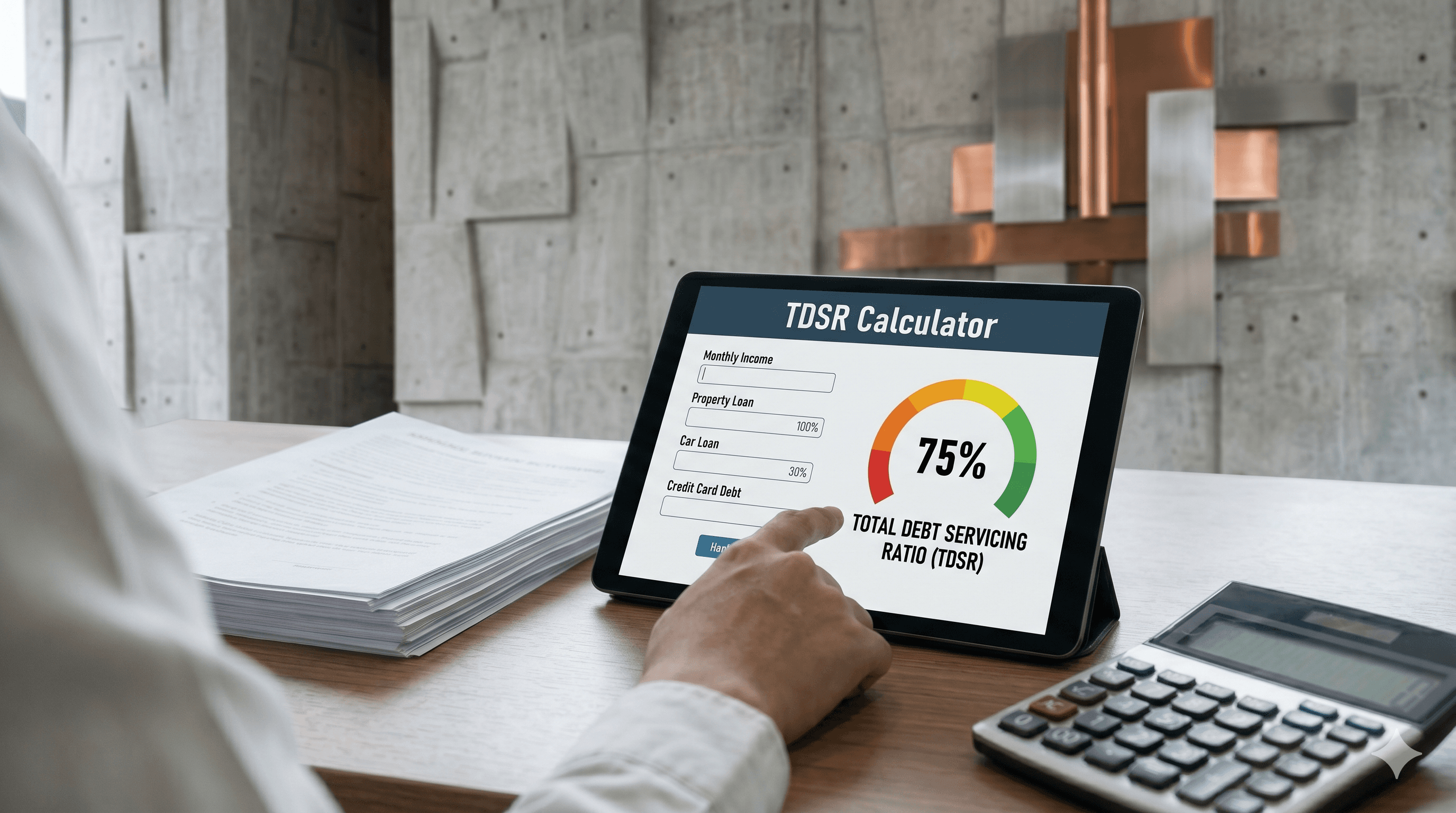
Apply MAS 55% Total Debt Servicing Ratio cap with 4% stress test rate to estimate your maximum mortgage and affordability ceiling.
$
$
$
$
$
MAS uses 4% for residential mortgage TDSR stress test.
Your TDSR Position
TDSR Limit (55% of income)$8,250/mo
Current Debt Commitments$0/mo
Remaining Debt Capacity$8,250/mo
Estimated Max Mortgage Principal$1,728,055
Rough Max Property Price (75% LTV)$2,304,074
Estimates based on TDSR 55% limit and MAS 4% stress test rate. Actual bank approval depends on your specific profile, credit history, variable income discounting, and the property being financed.
How TDSR Works
TDSR is MAS's tool to prevent over-leveraged borrowing in Singapore. It caps your total monthly debt repayments at 55% of your gross monthly income.
Formula: (All monthly debt obligations) ÷ (Gross monthly income) ≤ 55%
When you apply for a new property loan, banks calculate TDSR using the full 4% stress test rate on the new mortgage — even if the actual loan rate is lower (currently ~1.4-2.5% for fixed packages in 2026). This gives a buffer for future rate increases.
What Counts Toward Your TDSR
| Counts (Debt) | Doesn't Count |
|---|---|
| New mortgage at 4% stress rate | Utilities bills |
| Car loan monthly installment | Maintenance / condo fees |
| Credit card minimum payments | Insurance premiums |
| Personal / education loans | Subscriptions (Netflix etc.) |
| Existing home loans (if kept) | Income tax |
| Renovation loans | CPF contributions |
Income Treatment
- Fixed salary. Counted 100%
- Variable income (bonus, commission, rental). Typically 70% counted (30% haircut)
- Self-employed. Averaged over 2 years, subject to additional assessment
- Cash + fixed deposits. Some banks allow Pledging (divided over 4 years) or Show Funds (smaller impact)
TDSR vs MSR. Which Applies?
| Property Type | TDSR (55%) | MSR (30%) |
|---|---|---|
| HDB flat | Yes | Yes (stricter) |
| Executive Condominium (from developer) | Yes | Yes (stricter) |
| Private condo | Yes | No |
| Landed property | Yes | No |
For HDB/EC buyers, the binding constraint is usually MSR (30%), which is stricter than TDSR. For private condo and landed, only TDSR applies.
Frequently Asked Questions
What is TDSR in Singapore?
TDSR (Total Debt Servicing Ratio) is a regulation from the Monetary Authority of Singapore (MAS) that caps your total monthly debt repayments at 55% of your gross monthly income. This includes all debt. New mortgage, car loans, credit card minimum payments, personal loans, student loans, and other financial commitments.
Why does MAS use a 4% stress test rate?
For residential mortgage TDSR calculation, MAS requires banks to apply a 4% stress test interest rate (even if the actual loan rate is lower). This ensures you can still service the loan if interest rates rise. The 4% medium-term rate applies specifically to residential property loans.
What counts toward TDSR?
All monthly debt obligations: new mortgage (at stress test rate), car loan installment, credit card minimum payments, personal/education loans, existing home loans (if you're keeping them), and other recurring debt. Utilities, maintenance fees, and insurance do NOT count. They're not debt obligations.
How is variable income treated under TDSR?
Banks typically haircut variable income (bonuses, commissions, rental income) by 30%. So only 70% of the averaged variable income counts toward TDSR calculation. Fixed salary is counted in full. This is more conservative than the total gross income figure.
What's the difference between TDSR and MSR?
TDSR (55%) covers ALL debt and applies to all property types. MSR (Mortgage Servicing Ratio, 30%) only applies to HDB flats and Executive Condominiums and covers only the mortgage payment. For HDB/EC buyers, BOTH TDSR and MSR apply. Whichever is more restrictive determines your loan quantum.
Can I exceed TDSR with compensating factors?
Generally no. TDSR 55% is a hard regulatory cap. Banks cannot approve loans that push you above it. The only exceptions are refinancing of existing home loans (subject to conditions) and some bridging loans. For new purchases, you must stay within 55% TDSR.
How much home loan can I borrow in Singapore?
Your maximum loan depends on: (1) TDSR — total debt repayments cannot exceed 55% of gross monthly income, (2) LTV — first property max 75%, second 45%, third 35%, (3) MSR — for HDB/EC, mortgage cannot exceed 30% of income. Example: $15,000 monthly income, no other debt, at 4% stress test rate over 25 years = max loan roughly $1.07M = max property ~$1.43M at 75% LTV. Use the calculator above for your exact number.
What is the maximum TDSR ratio in Singapore?
The TDSR limit is 55% of your gross monthly income, set by MAS. This was tightened from 60% in December 2021. For HDB and EC buyers, MSR (30%) is the additional cap that usually binds first. The 55% is a hard cap — no bank can approve a loan that exceeds it.
Want me to run these numbers for your situation?
Drop your details and I'll work out the exact figures — ABSD, loan eligibility, monthly payment, and total cost — personalised to your profile.
Want to maximise your loan eligibility?
Jet works with mortgage brokers who can structure your income, debts, and loan application to optimise TDSR position. Free consultation.